The Rover can measure how far away things are. Students act as detectives: they guess distances with their eyes and arms, then use Check Front, Check Left and Check Right to measure, predict and compare.
At a Glance
- Year levels: Years 2–3
- Time: Two or three 25-minute sessions
- Blocks: Check Front, Check Left, Check Right, Forward, Turn Left, Turn Right
- You need: Tape grid with two boxes at least as tall as the Rover, a "wall" of books along the far edge and the right edge, block cards, a detective notebook (below), 1 Rover + 1 iPad per group of 3
What the Numbers Mean
| Block | Sensor | Sees |
|---|---|---|
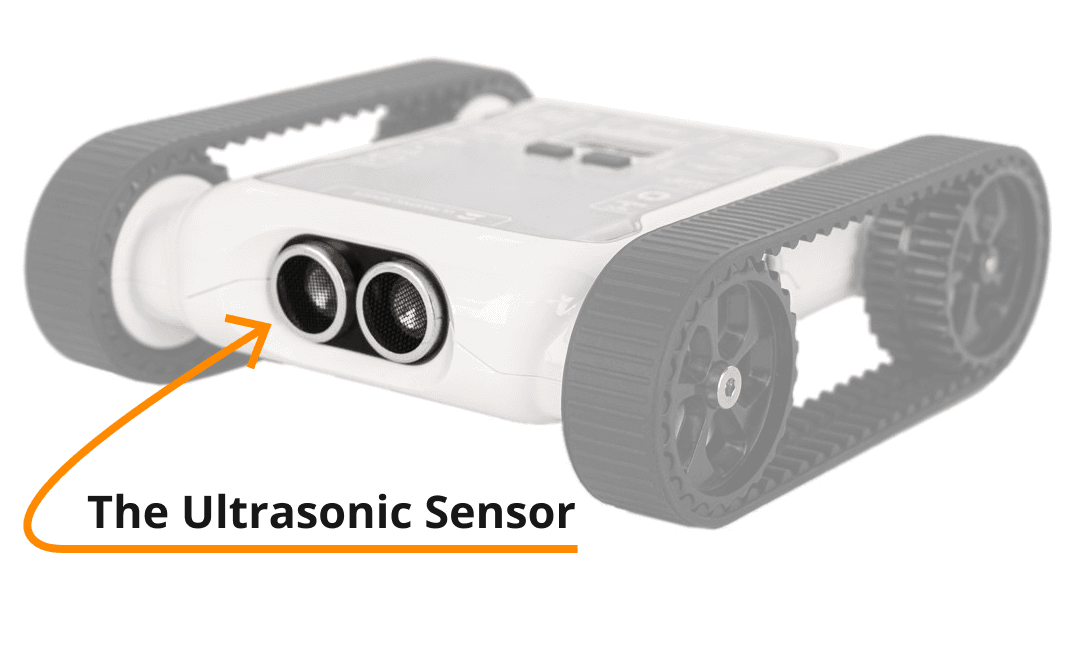
| Check Front | Ultrasonic | A long way (a wall across the room) |
| Check Left / Check Right | Infrared | Only close by, about a ruler's length |
- The numbers are centimetres. Smaller number = closer.
- Side sensors show their biggest number when nothing is near. If a side reading never changes, move the box closer.
I Can…
- predict if the number will get bigger or smaller
- use Check Left and Check Right to find which side is closer
- record my numbers in a table
- explain: "A small number means…"
Curriculum (Digital Technologies F–2 and 3–4): exploring digital systems (the Rover's sensors); programs that use input; patterns in data. Also Maths (comparing numbers, measurement) and Science (predicting and recording).
The Tape Grid

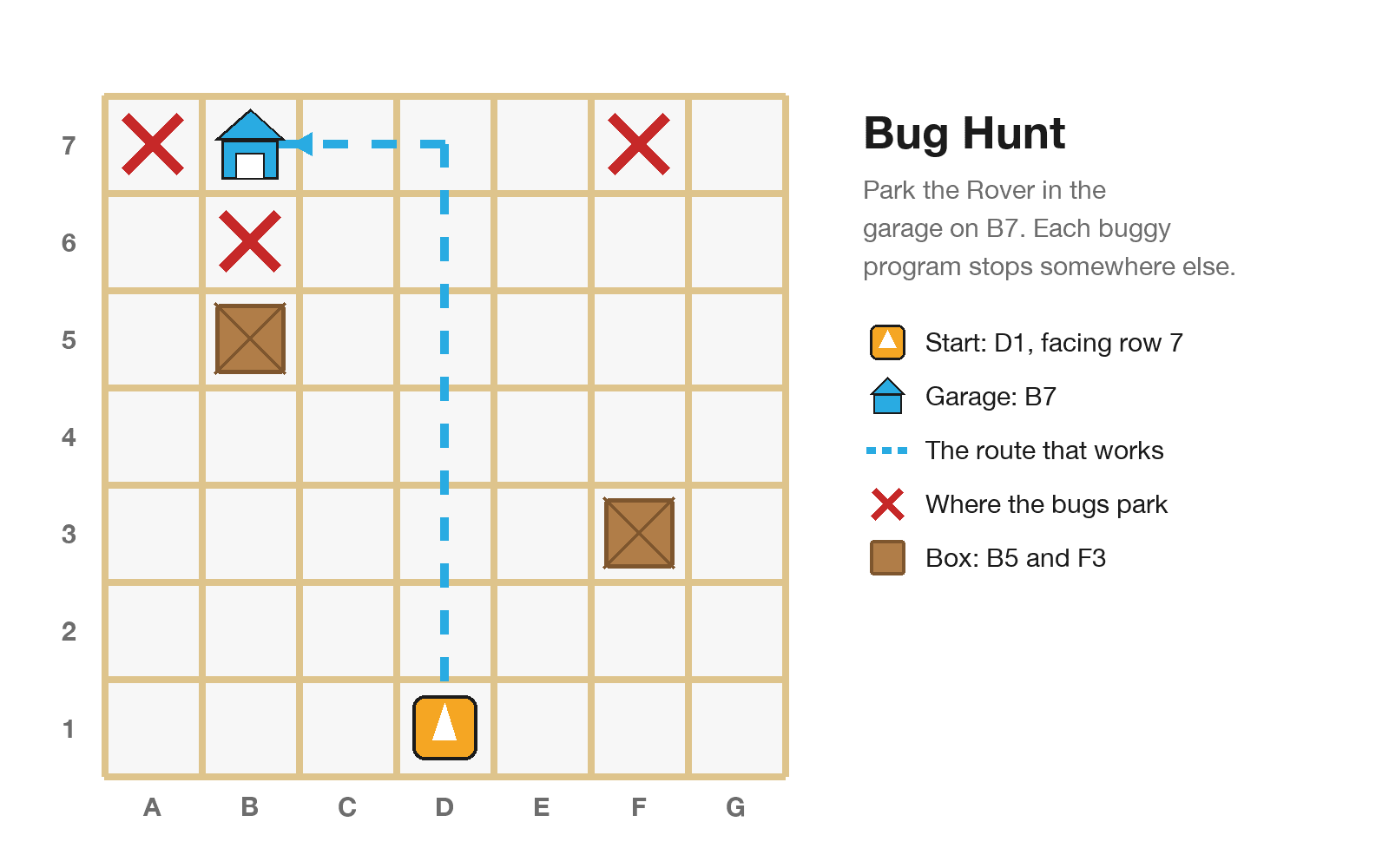
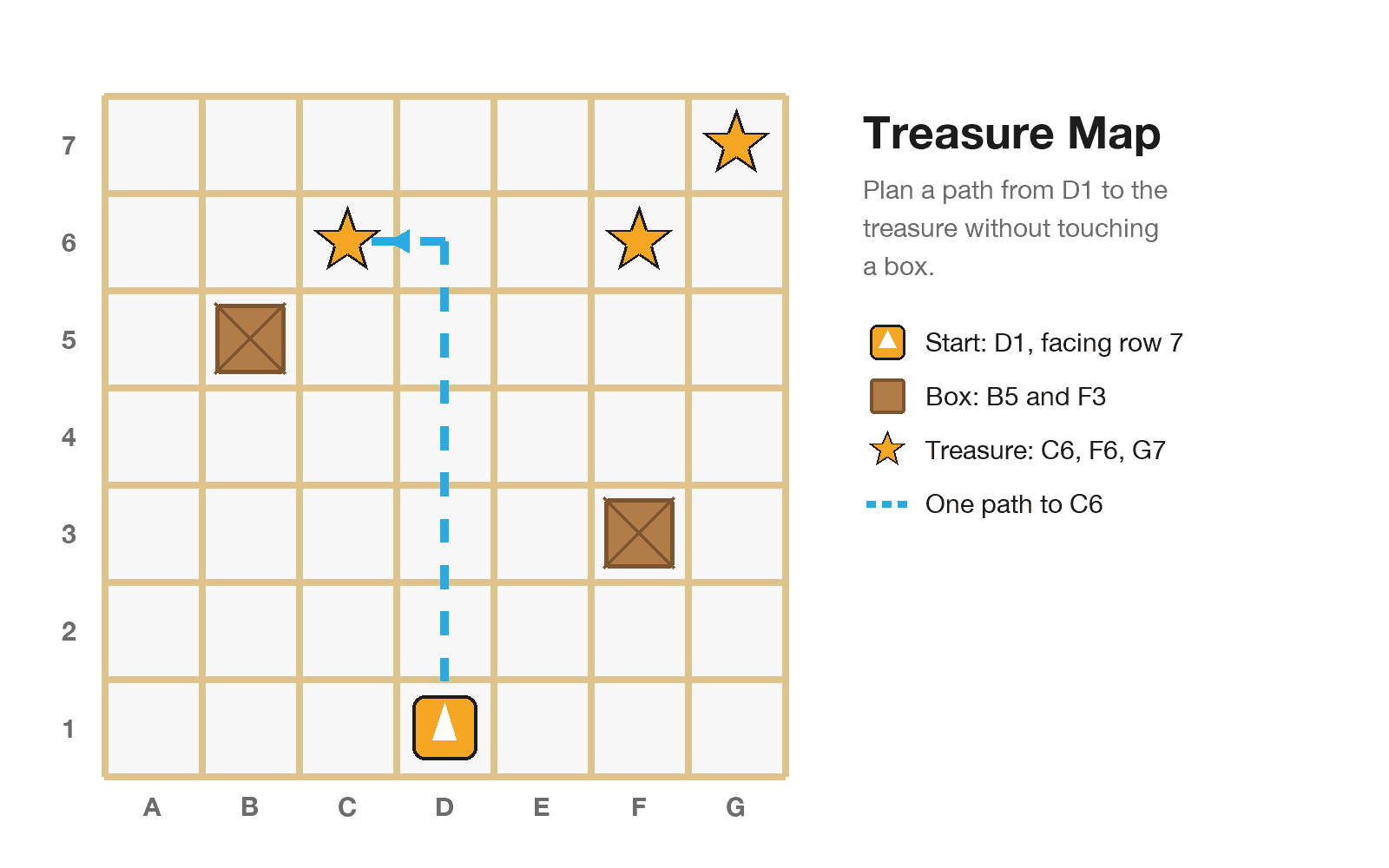
The Junior tape grid: 7 × 7 squares, start on D1, boxes on B5 and F3
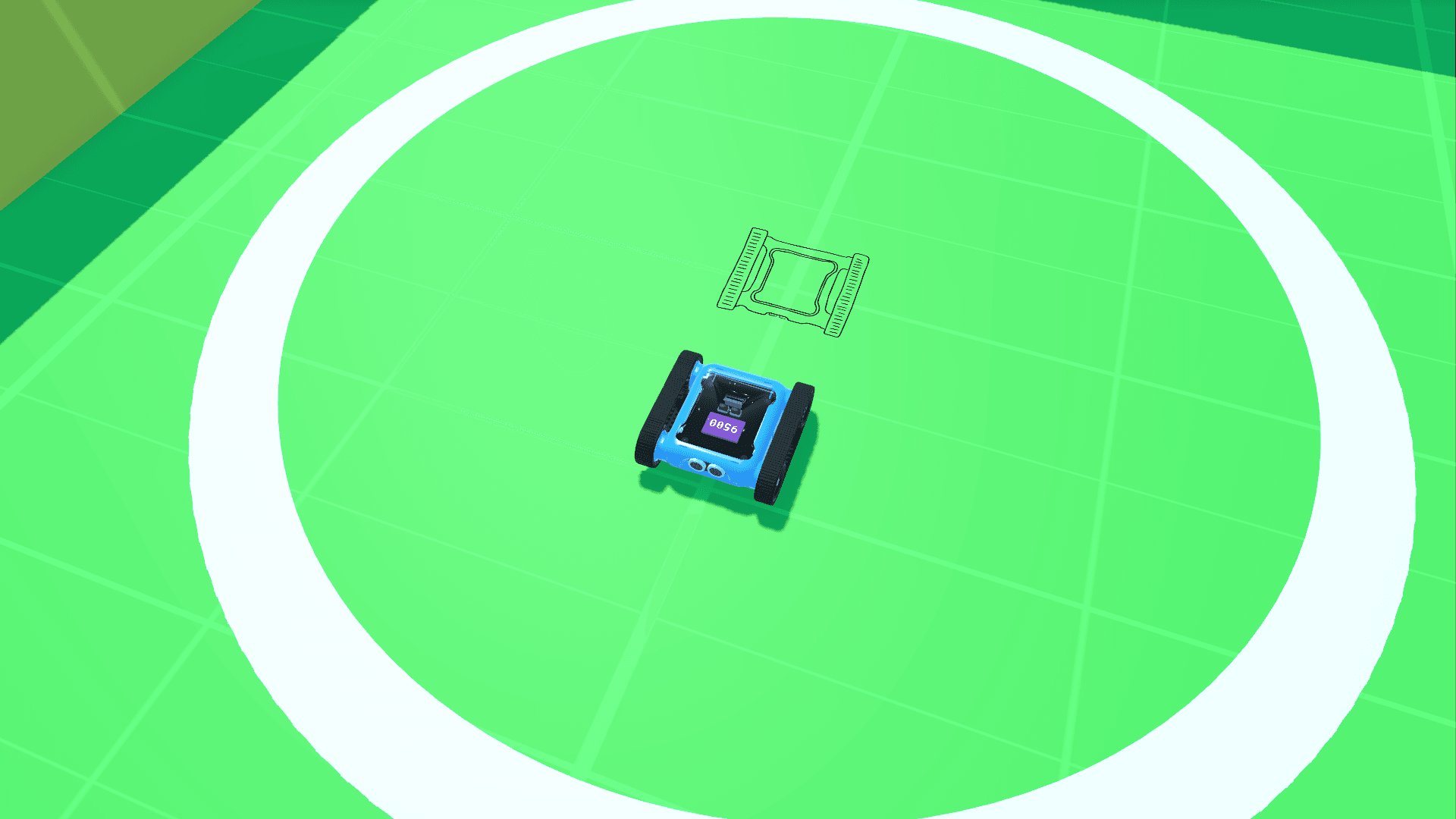
- Run one Forward and mark how far the Rover goes. That is your square size.
- Tape a 7 × 7 grid: columns A–G across, rows 1–7 going away from you.
- Start on D1, facing row 7. Boxes on B5 and F3.
- Build walls of books just past row 7 and just past column G.
Detective Notebook
| Where is the Rover? | Which Check? | I predict… | The number was… |
|---|---|---|---|
| D1 | Check Front | ||
| D3 | Check Front | ||
| D5 | Check Left | ||
| D5 | Check Right |
Warm-Up: Detective Eyes
- Teacher models. Stand on D1, look at the far wall: "I can't touch it. Two steps closer… now it's nearer."
- Pairs. The Programmer reads a Check card. The Rover points that way and says "near" or "far".
- Guess with your body: how many steps to the wall? How many arm-lengths to the box?
Movement break: "Closer or further?" Call "Step forward!" and students shout whether the wall is closer or further.
Predict → Run → Check
- Predict: "The number will be bigger / smaller than last time, because…" Write it down.
- Run: Rover on D1 facing row 7. Press Play and watch the numbers.
- Check: write the real number next to the prediction. Strange number? Walk the cards: where was the Rover, and which way was it facing?
Groups of 3: Programmer (iPad), Tester (Rover), Reporter (notebook). Swap every run.
Steps
1. Near and Far

Near and far: Check Front on D1, Forward twice, Check Front again on D3. The Rover is closer to the wall, so the second number is smaller
Ask: will the second number be bigger or smaller? (Smaller. The Rover is closer to the wall.)
2. The Mystery Box

The mystery box: Turn Right, Forward twice to F1, Turn Left to face the box on F3, Check Front, Forward to F2, Check Front again
Both numbers are small; the second is smaller still. Don't add another Forward: it would bump the box!
3. Which Side Is Closer?

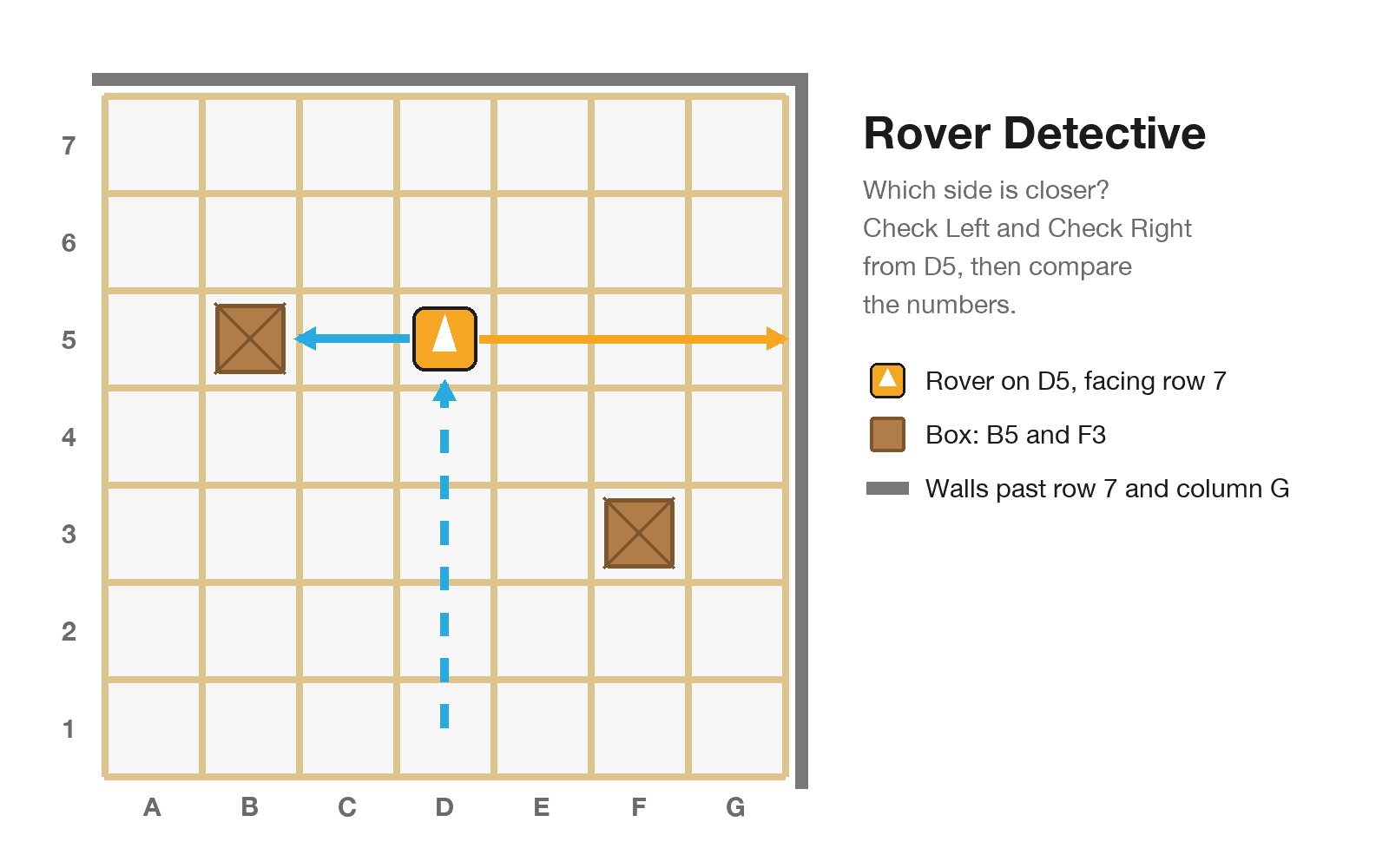
Which side is closer: Forward four times to D5, then Check Left towards the box on B5 and Check Right towards the wall past column G
Predict which number is smaller. The box on B5 is one square away; the wall is three, so Check Left wins. Then try from D3 or F5.
Make It Easier or Harder
- Easier: Step 1 only, saying "near" and "far" instead of reading numbers.
- Harder: Check Front after every Forward. What pattern do the numbers make?
Extensions
- Creep up on the wall: each run, add one Forward and one Check Front. Stop before the wall. (The numbers drop by about the same amount each step.)
- Upside-down mystery: run one Is Upside Down? block with the Rover flat, then held upside down. How does it know?
Teacher Tips
- Flat, hard boxes and books work best. Cushions and bags give odd numbers.
- Young students don't need units. "Smaller number, closer" is enough.
- A big side number that never changes means nothing is close. That's a discovery, not a bug.
Reflection
- Thumbs up, sideways or down: "I can predict if the number will get bigger or smaller."
- Finish the sentence: "The Rover knows how far away things are by…"