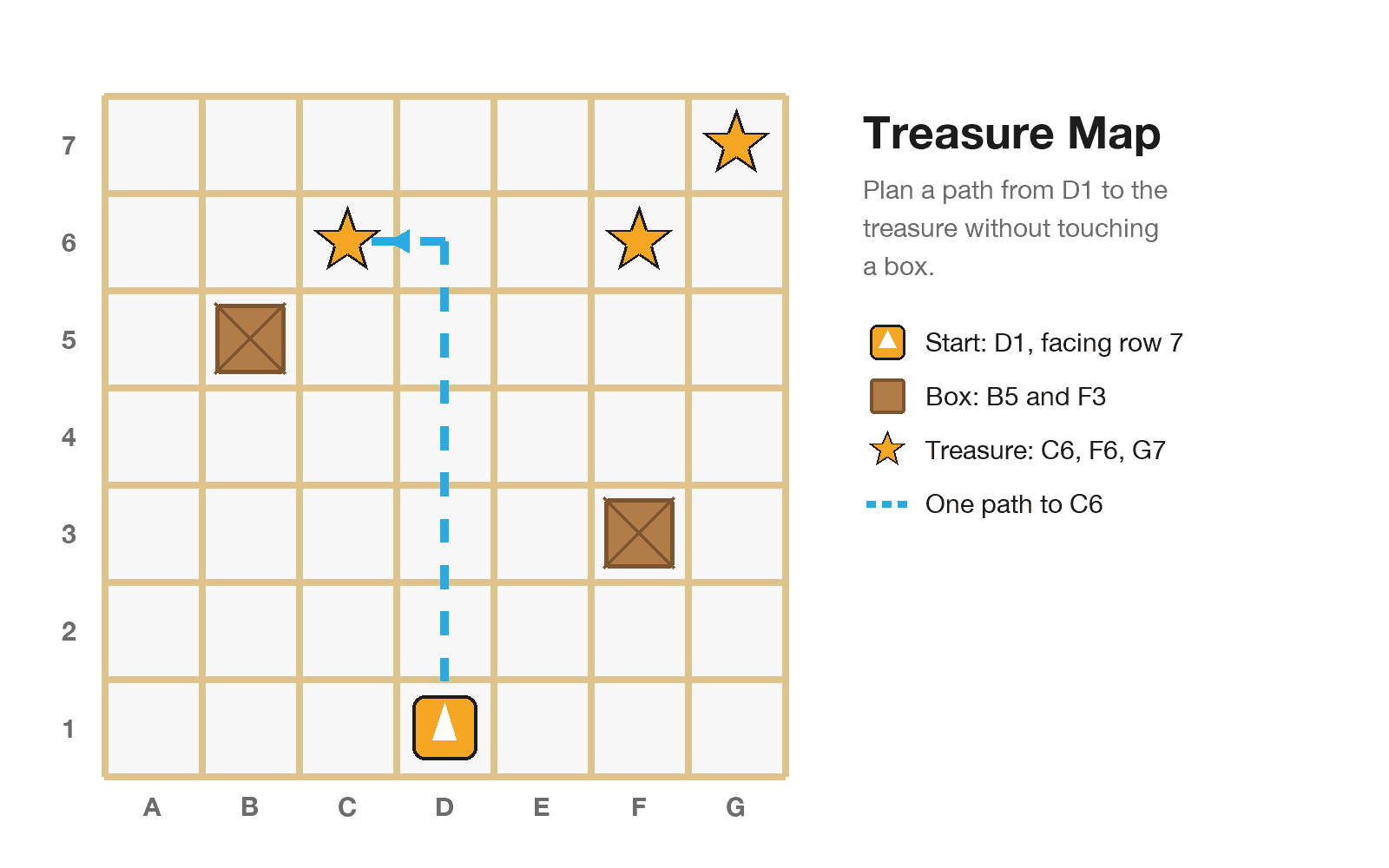
Somewhere on the grid there is buried treasure, and two crates are in the way. Students plan a path on a paper map, walk it as the Rover, then code the Rover to reach the treasure without touching a crate.
At a Glance
- Year levels: Years 1–3
- Time: Two or three 25-minute sessions
- Blocks: Forward, Turn Left, Turn Right (plus a light and a buzz to celebrate)
- You need: Tape grid with two boxes, a printed map per group (below), block cards, a paper star for the treasure, 1 Rover + 1 iPad per group of 3
I Can…
- find a square using its letter and number (like C6)
- draw a path to the treasure that misses the crates
- turn my path into block cards, in order
- predict where the Rover will be after each block
Curriculum (Digital Technologies F–2 and 3–4): following, then designing, algorithms as a sequence of steps. Also Maths (grid references, position, direction).
The Tape Grid and Map

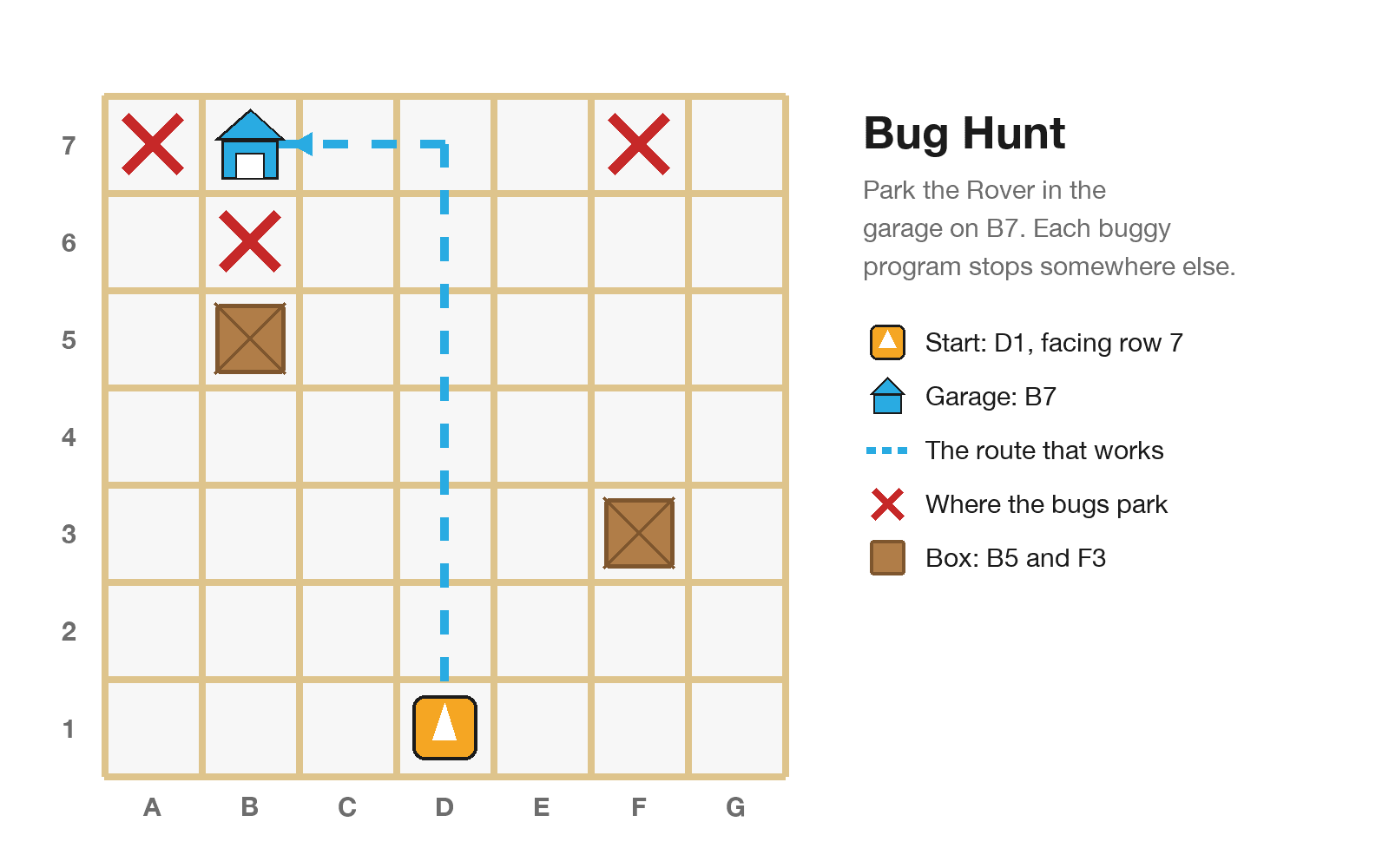
The Junior tape grid: 7 × 7 squares, start on D1, boxes on B5 and F3
- Run one Forward and mark how far the Rover goes. That is your square size.
- Tape a 7 × 7 grid: columns A–G across, rows 1–7 going away from you.
- Start on D1, facing row 7. Crates on B5 and F3. Put a paper star on the treasure square.
Print this map for each group. Students draw their path in pencil before coding.

Printable treasure map: the 7 × 7 grid with the start on D1, crates on B5 and F3, and treasure on C6, F6 and G7
Be the Rover First
- Teacher models. Stand on D1. Point to C6 and think aloud: "Up the D column to row 6, then one left. Forward five times, Turn Left, Forward."
- Pairs. The Programmer draws a path, then reads it as cards. The Rover walks it, counting: "Forward, D2. Forward, D3…"
- Check: on the treasure? Touched a crate? Back to the map. Then swap.
Movement break: call out a square ("E4!"). Everyone points to it on their map, then turns to face it.
Predict → Run → Check
- Predict: "The Rover will stop on… facing…"
- Run: Rover on D1 facing row 7. Press Play. Hands off!
- Check: treasure reached? Crate touched? If not, walk the cards and find the card where it went wrong.
Groups of 3: Programmer (iPad), Tester (Rover), Reporter (holds the map and ticks off squares). Swap every run.
Steps
1. Treasure on C6

Treasure on C6: Forward five times up the D column, Turn Left, Forward, then Make Lights Blue and Buzz High to celebrate
2. Treasure on F6

Treasure on F6: Forward five times, Turn Right, Forward twice. Turning right first leads into the crate on F3
Ask: what if we turned right first? Walk it on the grid. (Straight into the crate on F3.)
3. Treasure on G7

Treasure on G7: up then right takes 10 blocks; right then up takes 11
Two paths work. Count the blocks and compare: 10 or 11? Which is shorter?
Make It Easier or Harder
- Easier: treasure on D4 (straight ahead), then C2 (one turn).
- Harder: treasure that needs two turns, like A7 or G6.
Extensions
- Two treasures: collect C6, then F6. After C6 the Rover faces column A, so it must turn around first.
- Map for a friend: one group hides the treasure and writes the cards; another follows them.
Teacher Tips
- One session on paper and the tape grid, one session coding.
- Students often count the square they're standing on. Walking it fixes this: "You're on D1. Step. Now D2."
- A crate crash is a great result: now the group knows exactly what to fix.
Reflection
- Thumbs up, sideways or down: "I can plan a path before I code it."
- Draw your final path on the map and write how many blocks you used.